
ExpressVPN's Esports Partnerships
A Smart Brand Move For Modern Gaming

ExpressVPN’s latest gaming push is one of the smarter brand moves I’ve seen from a VPN company in a while. The company has expanded into esports through partnerships tied to the League of Legends EMEA Championship, VCT EMEA, VCT Americas, G2 Esports, and Method, while also launching a dedicated @ExpressVPN_Gaming social presence and tying the whole campaign to discounts and exclusive rewards. To me, that is not just another sponsorship splash. It is a clear attempt to plant the brand directly inside modern gaming culture. And honestly, I think it’s a VERY smart move.
Key Takeaways
ExpressVPN is not just advertising to gamers from the sidelines. It is pushing into the spaces where competitive gaming actually happens, with named partnerships across major Riot-linked properties and with recognisable organisations like G2 Esports and Method. It is also building a gaming-facing community layer around that push through its @ExpressVPN_Gaming channels and reward-led promotions.
What makes this interesting is that the move feels strategic rather than random. Gaming is one of the few audiences where a VPN story can sound natural instead of forced. Players already care about stability, routing, low-latency play, and protecting themselves online. ExpressVPN is leaning into that overlap in a way that makes business sense.
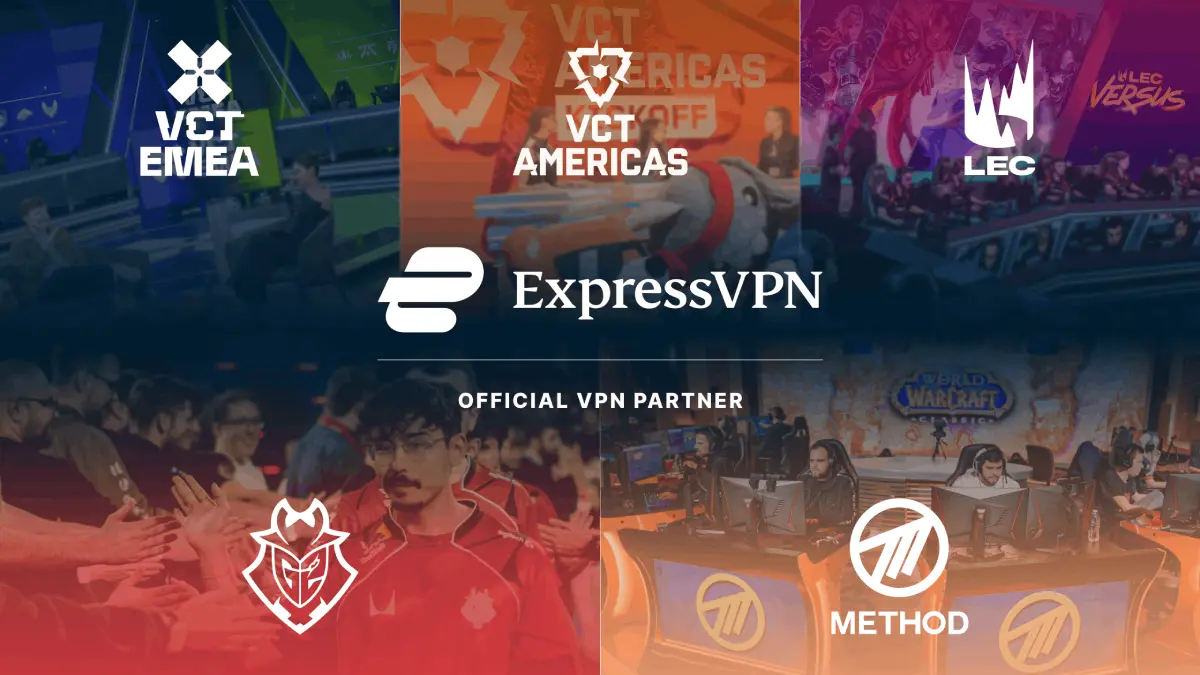
Image credit: ExpressVPN Blog
What the Partnerships Actually Include
According to ExpressVPN’s announcement, the company is now working with the League of Legends EMEA Championship, VCT EMEA, VCT Americas, G2 Esports, and Method. It is also using the launch to promote a new gaming-focused social space and a range of offers tied to different partner communities.
Those offers are a big part of the strategy. ExpressVPN says the campaign includes subscription discounts and community-specific extras such as a signed G2 jersey giveaway, League of Legends skins, Valorant accessories, and Method-linked social giveaways. That matters because it shows this is not just a passive branding deal. The company is trying to turn attention into engagement, and engagement into sign-ups.
Why I Think This is a VERY Smart Move
The smartest part of this whole campaign is the audience fit.
A lot of VPN marketing feels generic. It talks about privacy in broad, abstract terms and expects users to care. Gaming is different. In gaming, performance and protection are not abstract. Players care about whether their connection stays steady, whether their region access is flexible, whether they can avoid interruptions, and whether the service fits the way they actually play. ExpressVPN’s own announcement leans into exactly that by framing its network around low-latency performance, cross-region play, and consistent connections.
That is why I think this is a VERY smart move. ExpressVPN is not trying to invent a fake use case. It is stepping harder into a category where the pitch already makes sense. If you want to become more relevant to gamers, showing up inside esports, team culture, and creator communities is a much stronger move than throwing more generic ads into the void.
There is also a branding advantage here that goes beyond direct sales. When a VPN company places itself alongside recognisable esports properties, it starts to feel less like a background utility and more like part of the ecosystem. That shift matters. People are more likely to remember, trust, and talk about a product when it shows up in the spaces they already care about.
Why This Matters for Gamers
For gamers, the appeal is pretty easy to understand.
ExpressVPN is positioning itself as a service built for the way gaming works now: online, global, always connected, and often spread across multiple regions and communities. Its announcement points to a network spanning 105 countries and 170-plus server locations, while also highlighting Lightway and Smart Location as features intended to support faster, more stable connections and easier server selection.
That kind of messaging matters because gamers are not usually looking for a VPN in the same way a casual browser is. They are more likely to care about practical outcomes. Can the service help keep a session stable? Can it make cross-region play easier? Does it reduce the friction of getting set up quickly? Can it support the mix of gaming, voice chat, streaming, and community activity that often happens at the same time? Those are the real questions behind a gaming VPN purchase, and ExpressVPN is clearly trying to answer them with this campaign.
What This Move Gets Right
What ExpressVPN gets right here is tone.
Instead of talking to gamers like outsiders, it is trying to meet them where they already are. The company’s announcement is built around competition, creators, community, and rewards, not just technical jargon. That makes the campaign feel much more aligned with how gaming audiences actually engage with brands.
It also helps that ExpressVPN is not presenting this as a one-off moment. The launch of a dedicated gaming channel suggests the company wants an ongoing presence rather than a short headline burst. That is another reason I see this as a smart move. Long term, the brands that win in gaming are usually the ones that keep showing up consistently, not the ones that make one loud announcement and disappear.
What This Does Not Prove
At the same time, it is worth staying honest about what these partnerships actually mean.
They do not automatically prove that ExpressVPN is the best gaming VPN on the market. They do not prove it will lower latency for every player, improve every route, or outperform every rival in every region. What they do prove is that ExpressVPN is serious about gaming as a category and is investing in the branding side of that position.
That distinction matters. Great partnerships can build trust, visibility, and relevance, but they are not a substitute for real-world performance. A gamer still has to judge any VPN by how it actually behaves on their setup, with their ISP, in their region, and in the games they play most. This campaign strengthens the brand story. It does not settle the performance question on its own.
Should Gamers Care? My Take.
Yes, but for the right reasons.
Gamers should care because this shows where ExpressVPN wants to go as a brand. It wants to be more than a general-purpose privacy tool. It wants to be part of the conversation around competitive play, team culture, creators, and connected gaming communities. That makes the brand more interesting to watch, and for the right user, potentially more appealing to buy.
But gamers should not care only because a logo showed up next to a tournament or a team. The better reason to care is that ExpressVPN is aligning its marketing with a use case that already feels credible. If the product side holds up, this kind of campaign could help it become much more relevant in gaming than many other VPN brands that still feel vague or generic.
My view is pretty simple: this is a VERY smart move from ExpressVPN. It is smart because the audience fit is obvious. It is smart because gaming already overlaps with some of the strongest reasons people use VPNs. It is smart because esports gives the brand cultural relevance that normal VPN ads rarely achieve. And it is smart because rewards, community channels, and recognisable team partnerships make the campaign feel active rather than cosmetic.
The only thing I would not do is confuse a smart brand move with a final technical verdict. Those are different things. ExpressVPN has clearly made itself more visible, more current, and more credible inside gaming culture. Whether it becomes the clear first choice for every gamer still depends on performance in the real world. You can read our detailed ExpressVPN review to see how it performs practically. But as a branding play, I think this is one of the better moves a VPN company could make right now.